
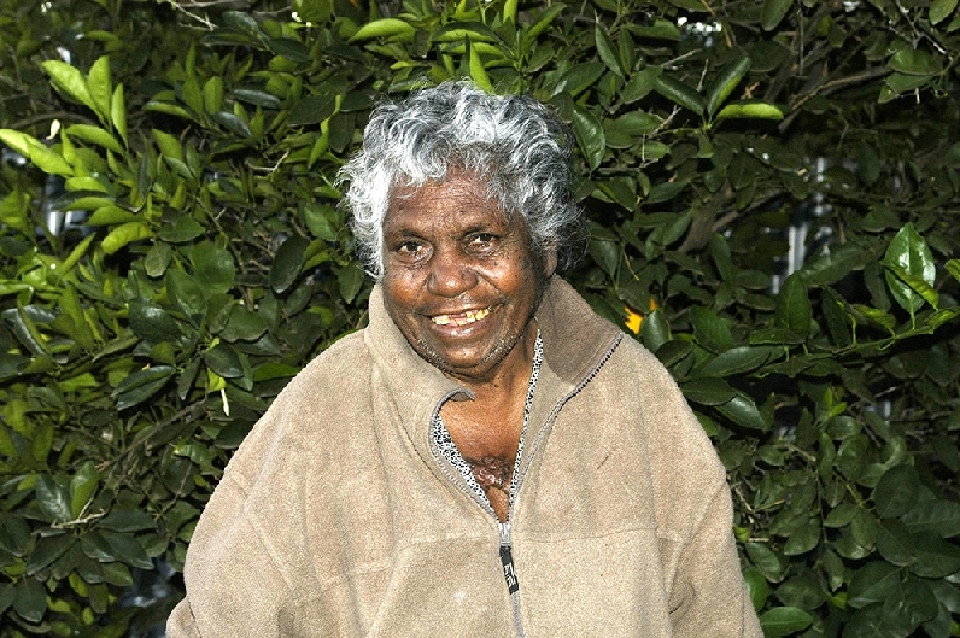
Gloria Petyarre
DOB:
c.1942 - 2021
Born:
Mosquito Bore, Utopia, Northern Territory
LANGUAGE GROUP: Anmatyerre
COMMUNITY: Utopia, NT
Gloria Petyarre (also known as Gloria Pitjara) was one of Australia's most significant and successful Indigenous artists. She is best known for her distinctive depictions of Kurrajong bush medicine leaves, rendered through layered, free-flowing brushstrokes that sweep and scatter across the canvas. This motif became her signature and remains one of the most recognisable visual languages in contemporary Aboriginal art.
Her national prominence was cemented in 1999 when she became the first Indigenous Australian artist to win the Wynne Prize for Landscape at the Art Gallery of New South Wales. The winning work marked a pivotal moment in Australian art. Vast in scale and composed of shimmering gold and green leaf forms set against a dark ground, the painting conveyed the movement of wind through foliage, the shifting rhythms of tide and grasslands, and an immersive sense of natural energy. Its impact was immediate and far-reaching, resonating strongly with audiences and helping to broaden appreciation for Aboriginal art across the country.
Petyarre continued to explore and refine this visual language for more than two decades, until her retirement in 2019 due to ill health. While her style has since been adopted and reinterpreted by members of her extended family, she is widely recognised as its originator and most accomplished exponent.
She was born in Utopia, a remote region approximately 230-300 kilometres north-east of Alice Springs. This area has produced many of Australia's leading Indigenous artists, including Emily Kame Kngwarreye, one of the most celebrated figures in Australian art. While not directly related, Petyarre and Kngwarreye were closely connected through kinship ties and shared cultural networks, and were dear friends as well as contemporaries. Both women were central figures in the emergence of the Utopia art movement and developed their practices alongside one another.
Petyarre's artistic journey began in 1977 as part of the Utopia Women's Batik Group, an initiative facilitated by the Central Australian Aboriginal Media Association (CAAMA). As a founding member, she worked alongside other women to create batik and tie-dye textiles, a project that achieved considerable success both nationally and internationally.
In 1988, CAAMA introduced canvas painting to the Utopia artists, marking a major shift in medium. Petyarre and her peers embraced this transition with enthusiasm, finding new expressive possibilities in paint. The resulting works were exhibited widely, including in Sydney, and attracted significant attention. This period is now recognised as the foundation of the Utopia art movement, with Petyarre at its centre.
As demand for Utopian art grew, so too did her career. She exhibited extensively across Australia and internationally, with shows in Europe, the United Kingdom, the United States, and Japan. Although widely associated with her bush medicine leaf paintings, her practice encompassed a rich range of Dreaming stories, including Thorny Mountain Devil Lizard, Yam, Grass Seed, Pencil Yam, Emu, Bean, Small Brown Grass, and Body Paint Dreamings. These works demonstrate both her versatility and her deep cultural knowledge.
Later in her career, Petyarre expanded her practice to include large-scale "Big Leaf" paintings. These works, characterised by bold, gestural brushstrokes and dynamic colour blending, reveal a more expressionistic approach and a palpable sense of joy in the act of painting.
A highly awarded and widely collected artist, Petyarre was a finalist in the Wynne Prize on multiple occasions and was regularly represented in the Telstra National Aboriginal and Torres Strait Islander Art Awards. Her work is held in major public and private collections in Australia and internationally.
Her legacy continues to be recognised through major exhibitions, including Connection: Songlines from Australia's First Peoples at the National Museum of Australia (2022) and its subsequent presentation at The Lume, Melbourne (2024). She has also been the subject of portraits held in the National Portrait Gallery, reflecting her enduring cultural influence and the profound impression she made on those around her.
Beyond her artistic achievements, Petyarre was remembered for her warmth, generosity, and deep connection to Country. She shared her stories and knowledge with openness and joy, leaving a lasting impression on all who met her. Her spirit lives on through her paintings, which continue to carry the energy, movement, and cultural significance that defined her life and work.
She is deeply missed.
Copyright Kate Owen Gallery, April 2026