Polly Ngale | Arnwetky Exhibition

On display in the charcoal gallery. Can't visit the gallery? View our online exhibition here.

 
click on image above to view the exhibition catalogue

Polly Ngale is one of the most senior custodians of her country Ahalpere, in the heart of Utopia, located in the north west corner of the Simpson desert and roughly 350km north east of Alice Springs, along the Sandover Highway.

Polly in considered one of the most accomplished painters from the Utopia region and is inspired by the Arnwetky (conkerberry) – a green tangled, spiny shrub that produces fragrant white flowers. After the summer rains tiny green berries begin to grow and ripen, changing colour over the weeks from light green to pinks and browns to yellow, to shades of red and purple when they finally ripen. The fruits very much resemble a plum and is often referred to in English by Polly as a ‘bush plum’. The Arnwetky is a popular variety of bush tucker for the people of Utopia, as well as possessing medicinal properties.

During the Dreamtime, winds came from all directions, carrying the Arnwetky seed all over Polly’s ancestors’ Anmatyerre land. To ensure the continued fruiting of the Arnwetky, the Anmatyerre people pay homage to the spirit of the bush plum by recreating it in their ceremonies through song and dance, and in recent years, through painting. The patterns in the paintings can represent the fruit of the plant, its leaves and flowers, and also the body paint designs that are associated with it during ceremony.

For Anmatyerre women, the bush plum is a source of physical and spiritual sustenance - reminding them of the sacredness of Ahalpere country. Its story is crucial to Anmatyerre women's ceremonies.

Polly’s depictions of Arnwetky are the accumulation of a lifetime's knowledge about the country that she loves and feels a personal responsibility to care for. The power of the art resonates across geographical, botanical and spiritual dimensions.

In recent years, Polly has undergone a renaissance in her work - by all accounts producing some of the finest paintings of her career to date.

Kate Owen Gallery is delighted to present Polly Ngale’s new body of work, which showcases her exuberant and masterful depiction of Arnwetky .

Read More:

Polly Ngale's Bush Plum


Defining Tradition | black & white

We are delighted to present our third exhibition in the 'defining tradition' exhibition series. In this show, we are celebrating the trailblazing artists who moved away from colour and pursued a more minimalistic style. Inspired by ancient Dreamings and the Australian landscape, their works are restrained in colour palette, yet remarkably powerful with exceptional compositional designs.


Article

On display are the great trailblazers such as Dorothy Napangardi and Lily Kely Napangardi. Dorothy’s early years at Mina Mina (where she lived a traditional bush life), along with the sacred Dreaming stories that inhabit the land, are the inspiration and subject of her work. 

Dorothy’s early artistic endeavours consisted on subject matter such as Bush Plum and Bush Banana – wild fruits that grow in abundance around Mina Mina – depicted in vibrant acrylic tones. Even at this stage, her superb sense of composition was evident. When Dorothy had the opportunity to return to Mina Mina in the mid 2000s*, she had the opportunity to be inspired by the landscape, and  her work developed towards a previously unseen abstracted method of Aboriginal art – all iconography pared back to the barest essentials. Just as Dorothy’s visual effects are subtle and intriguing, so too are their connection to culture and country.

The Australian art world instantly took note of this trailblazer. In 2002 her major solo exhibition (and the first solo exhibition for an Indigenous Australian artist) opened to considerable acclaim at Sydney's Museum of Contemporary Art, and later toured Asia. In 2012 she became the first indigenous Australian artist to have work accepted by Art Cologne, and in the same year her work was displayed in Ancestral Modern, an exhibition at the Seattle Art Museum. Since Dorothy’s passing, the New York MET has acquired one of her pieces, and there has been a retrospective exhibition at the Seatle Art Museum.

Also on display are the gestural artists such as Charmaine Pwerle. Daughter of Barbara Weir and granddaughter of Minnie Pwerle, Charmaine hails from one of Aboriginal art’s great painting dynasties. Whilst it is tempting to look at Charmaine's artworks in light of her famous relatives, her art demands attention in its own right.

It makes its own statements.

Charmaine’s subject matter draws on stories passed down for generations, but approaches it in a wholly different fashion than her grandmother to whom she is so often compared.

Defining Tradition | black + white also showcases artists who employ exceptionally fine dot work and complex designs, such as Anna Price Petyarre and Dulcie Long Pula.

Like their forebears from Utopia, Anna and Dulcie continue to astound the art world with their distinct and rich artworks, in recent years both having branched out and pursued a more minimalistic style. Exhibiting a restrained colour palette, their works demonstrate an exceptionally fine attention to detail, highlighted by complex designs and fascinating insights into the deep underlying cultural meaning associated with their artworks.

We also present pieces in this exhibition by Clifford Possum and Helen McCarthy Tyalmuty, who have used a black and white colour palette to present stories that are of a more ominous, sombre tone. Follow the links below to find out more about these artwork stories:


Click here to read the story of Awurrapun


Click here to read the story of The Tjangala Brothers


Click here to read our recent blog piece: Understanding Colour 

We look forward to seeing you in the gallery soon to see this incredible display of works!

* Mina Mina is now uninhabited desert country west of Nyirripi,  since the Warlpiri people’s move into communities Nyirripi and Yeundumu.


 Black & White Art at Home

Love the artworks on display in this exhibition, but are uncertain as to how to incorporate them in to your home or office space? Here is some advice from one of our Senior Art Consultants, Surrey:

The use of black and white Indigenous paintings for contemporary interior spaces create an unquestionably sophisticated and elegant look.  The monochrome allows the viewer to focus on the power of the composition, the ancient narratives behind the designs.

Used in modern interiors these striking artworks are often combined with sleek metals and rich timber surfaces and help create enviable calm, contemporary spaces that feel uncluttered and easy to live in.

Interested in arranging a home trial, digital hang, or using one of our other gallery services? Contact Us and one of our friendly Art Consultants will be able to assist you.


Gallery News - April 2019

What an incredible start to the year it has been for the KOG Crew. Here's a summary of 2019 so far;

exhibitions and artist in residence programs

So far we've held two exhibitions in our 'defining tradition' series, with more planned later in the year and extending in to the 2020 exhibition schedule. This weekend will be the official launch of our exhibition seven sisters where artists Andrea Adamson, Athena Nangala Granites and Gabriella Possum Nungurrayi depict the epic Aboriginal Dreamtime story of an Ancestral Being in the guise of a man - who relentlessly pursues seven sisters (Ancestral Women) over land and sky. It is a tale of lust, love, passion and danger. We are hanging the exhibition this week and it is a cracking selection of works - this exhibition is a must-see! Follow the links below to find out more about our past and current exhibitions.

We know our artist in residence program is hugely popular and we are planning to have another one this year, but please be advised that many of the artists we represent have great family and cultural responsibilities meaning plans can change at a moments notice. To stay up to date with the latest news on our artist in residence programs, sign up to our mailing list.

What other exhibitions do we have in store for 2019? Well, we like to keep it a surprise! But if you're a fan of Barbara Weir, Karen Napaltjarri Barnes, Helen McCarthy or just love black and white artworks - watch this space! We'll have some exciting news for you shortly.

artist awards & recognition

A big CONGRATULATIONS to Lockhart River artist Fiona Omeenyo who is a finalist in this years Montalto Sculpture Prize! Fiona's work has been widely exhibited in Australian galleries since winning her first art award in 2001. She has had 15 solo exhibitions and over 40 group exhibitions, as well as being represented in many private and public collections including the National Gallery of Victoria and QUT Art Museum. View Fiona's latest body of work here

We also send our CONGRATULATIONS to Helen McCarthy Tyalmuty - selected as a finalist in the 2019 Calleen Art Award! The acquisitive painting prize is held at the Cowra Regional Art Gallery each year. The winner is announced on Saturday 4 May.

Helen McCarthy Tyalmuty 'Marrawuk (Start of the Wet)' - HMCG0112A  119 x 200cm

Already winner of the Peoples Choice Award at the 2007 Telstra National Aboriginal & Torres Strait Islander Art Award, in 2017 Helen appeared as a finalist in prestigious art prizes such as the Paddington Art Prize, the Georges River Art Prize, and was awarded the Inaugural Margaret Olley Art Award at the Mosman Art Prize. Over the last eighteen months Helen has spent time in Alice Springs, Darwin, Daly River and Sydney, with 2019 promising to be another exciting year of creative output.

Click here to view our extraordinary collection of works from Helen McCarthy Tyalmuty including brand new artworks.

gallery awards & recognition

The KOG Crew are still buzzing after being named Champion Specialised Retail Small Business for 2019 at The Australian Small Business Champion Gala Dinner and Awards Ceremony held on Saturday 6 April with over 1,100 guests in attendance. Daniel, Surrey and Liz were in attendance and received an award statuette, certificate and gained national recognition as an industry leader. Here at Kate Owen Gallery, we couldn’t do what we do without the incredible artists who choose to bless us with their art and our wonderful clients, so a big heartfelt THANK YOU!

We've also just received the news that our loyal clients have voted for us in the 2019 Inner West Local Business Awards and we have been named as a FINALIST! Our sincere thanks for your loyalty and support over the years. 2019 is certainly turning out to be an exciting year for Kate Owen Gallery!


Defining Tradition | The Colourists

Welcome to our second exhibition in the ‘defining tradition’ exhibition series. In this show, we’re celebrating the trailblazing artists who pursued an adventurous use of colour. 


article | related videos | exhibition catalogue | online exhibition
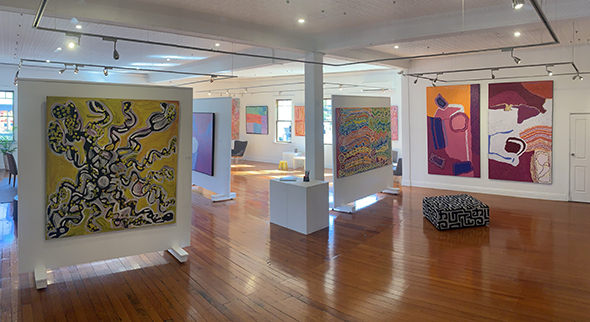


Our inaugural ‘defining tradition’ exhibition in January, titled ‘the first wave & its disciples’, focused on the genesis of the western desert art movement at Papunya in 1971, when senior men essentially invented a new art form. We presented artists that have remained the faithful disciples of the muted colour palettes and powerful expression of Tjukurrpa (Dreaming) as first set down by those pioneers of western desert art. 

For many visitors to the gallery, the natural ochre pigments on display are what they had considered ‘traditional’ or the quintessential colours of Aboriginal art. Our second exhibition, ‘the colourists’, unveils that in experimenting with acrylics in Papunya in the 1970s, another great tradition was ignited - the use of bright colour.

As we completed hanging ‘the colourists’ exhibition, we couldn’t help but feel that the space was brighter, lighter and felt more uplifting. Our eyes were dancing around the space as we followed the sensuous pinks and reds found in Tommy Watson’s artworks, travelled across the dynamic lines of colour in Judy Watson Napangardi’s work, and felt the raw power in Lorna Fencer’s ‘Warna (Snake)’.

Before we delve deeper and discuss some of the fantastic artworks on display, we need to take a moment and debunk the notion that there’s none of this vibrant colour occurring naturally in the Australian landscape; that these artworks are somehow not an accurate or ‘authentic’ depiction of the Australian landscape. As I leave the urban jungle of Sydney - with its hazy air and restricted colour palette - and head to the ‘red centre’ of Alice Springs, the difference in colour is immense. The clean air, the bright Australian light and sensational contrasting colours sends my colour perception off the scale and everything is more intense. The mineral rich earth and stone also reflects a multitude of colours - making sunrise and sunset an incredibly magical time of the day. Everything does just seem more rich and vibrant in this special part of the world, with many landscape photographers commenting they have rarely seen the intensity of natural colour as found in our own backyard.

And then there is that magical time of the year, when for a few weeks the desert is blanketed with wildflowers. As far as the eye can see, there are vibrant splashes of blue, purple, yellow, along with more subtle pastel hues. It can be argued that many of the artists represented in this show are simply painting with colours they have experienced on Country. For me, this is perfectly typified by Polly Ngale’s gorgeous piece titled ‘Bush Plum’. Polly Ngale belongs to the oldest living generation of Utopia women and is considered one of the most accomplished painters to have worked there during the past twenty years. Polly’s artistic career began in the late 1970s when she, like many of the women in Utopia, began working with silk batik before venturing into works on canvas[1].
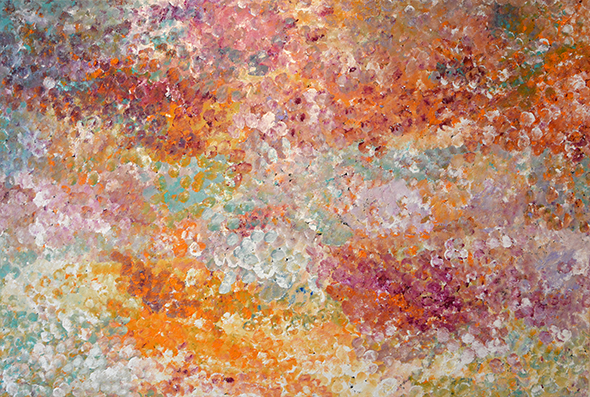
Polly Ngale ' Bush Plum' PNGG0024 

Most of Polly Ngale's paintings are centred around the 'Bush Plum'(or Conkerberry tree) and range from extremely fine dotting techniques with either interspersed colours or areas of varying colours and depth all blending together across the canvas. Through extensive over-dotting, she builds up layers of colour, blending or separate, to give a wealth of different and very attractive paint effects.

The Bush Plum - which is central to many of the works of artists’ of the Utopia community - provides an important food source for the Anmatyerre people and is frequently featured in the Women's dreaming stories. The fruits are harvested by shaking the trees until they fall to the ground but the fruits, although already quite sweet, need to be soaked in water to soften and plump them up for eating. The Bush Plum tree flowers in Spring and many of Polly's paintings have a distinctly Springtime air to them - one can readily sense a host of blossoms in her works.

Alternatively, some artists have used an adventurous colour palette to capture the energy or emotion of a site or Tjukurrpa (Dreaming). Lockhart River artist Samantha Hobson has an incredible ability to capture the colour and intensity of a moment and transform its radiant energy into an emotional charge pulsating through the artwork. Her Great Barrier Reef Series captures the jewel like quality of this pristine natural wonder, with bold splashes of paint conjuring those twinkling seconds a wave breaks. Her Series leaves the viewer feeling energised, much like a dip in the fresh saltwater.  Art historian Sally Butler perfectly explains Samantha Hobson’s work as “close to abstract expressionism, but there is always something that keeps it in touch with visible reality. This is because her art is about seeing the world, not a way of imagining it”. 
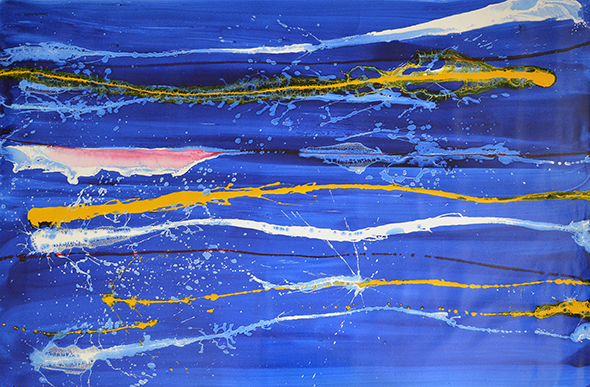
Samantha Hobson 'Great Barrier Reef Series - Coral Sea Dreaming III' SH20170909 

Another fantastic example of colour being used to express an emotion is Betty Mbitjana’s ‘Awelye’ - in this artwork Betty depicts the designs that the women would paint on their bodies, and the dancing tracks which are made in the sand during the women's awelye ceremony. Betty has chosen an array of bright, bold colours.  For me, this is the happiest artwork of the entire exhibition. If feels as if Betty is expressing the joy and celebration that occurs during the awelye ceremony. Betty’s artworks have a fantastic sense of greeting, and have a very uplifting effect in any area where they hang.

Another interesting item to consider when viewing ‘the colourists’ exhibition is how the artist has applied colour to the canvas. It is well known that the late Kudditji Kngwarreye would sing while he painted, as if to infuse the paint with his songlines and stories of Country. In the case of Judy Watson Napangardi, her brush was loaded with original and vital colour which she shuffled across the canvas, never losing connection between the brush and canvas. Interestingly, it is said that the ancestral women danced across country, and Warlpiri women of today channel their ancestors when they dance in ceremony, shuffling through the sand, never losing connection to Country. The method in which the paint has been applied could also imply a deep, ancient tradition. 
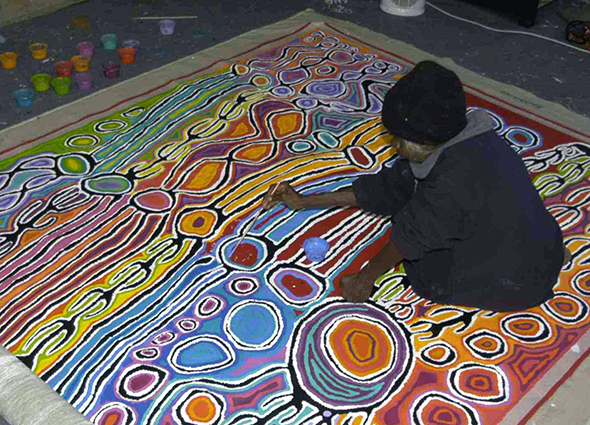
 Judy Watson Napangardi painting

Judy Watson Napangardi was one of the trailblazing artists at Yuendumu, who cemented Warlukurlangu Art Centre’s reputation for their bold use of colour through an unrestricted palette[2]. Another early distinctive feature was the use of very traditional iconography. As explained by Warlukurlangu Art Centre, “the artists painted Jukurrpa (dreaming story), ensuring appropriate Warlpiri relationships of kirda (owners) and kurdugurlu (guardians) were followed and the images reflected the social and cultural obligations present in ceremonies and day-to-day life in the community. The kurawarri, the iconographic elements of a painting that held the story, were painted first and scrutinized by others for their adherence to Jukurrpa. The dotting that filled the canvases was less important, and many artists developed varying styles of application and experimented with different colours while maintaining a consistency in their presentation of kuruwarri”.

Nowadays, the paintings tell the story of the artists’ connection to their country, the features of the landscape, the plants and animals that are found there and the creation story that occurred in the Dreamtime. These stories are still very relevant to the artists today. Artists have their own particular styles or palettes, and constantly experiment and vary their paintings, so the works are constantly evolving.

As I walk through ‘the colourists’ exhibition, I also love how the art captures a sense of the artists personality - none more so than the incomparable Lorna Fencer Napurrula. We have created our own Lorna Fencer Photo Page to give you some insight into the persona of the artist and I think help to put her bold and uncompromising artwork into context.

Whilst many of the trailblazing artists featured in the show are no longer with us, it is heartening to see the next generation taking up the brush. In this exhibition alone we have artworks by the great Minnie Pwerle, her daughters Betty Mbitjana and Barbara Weir, and granddaughter Charmaine Pwerle (Barbara Weir’s daughter).

Coming away from ‘defining tradition | the colourist’ exhibition, I realise that no artist can work in a vacuum. We are all influenced by what we see around us. Painters are influenced by what other painters did before them. The colours we see and use, the effects in nature we try to convey, the things which inspire us and make us want to paint; all these reactions are conditioned by the traditions we respect and the influences and conventions we absorb - many of them unconsciously.

I encourage you all to see this monumental display of artworks and get some colour into your life!

 Related Videos


[1] Preceding the expansion of the Papunya Tula movement to communities such as Yuendumu and Balgo Hills in the mid 1980s, Pitjantjatjara women in Ernabella and Anmnatyerr/Alyawarr women at Utopia station celebrated colour in their fluid batiks, before making the transition to canvas in the late 1980’s, when the art world really began to take notice.

[2] In the early 1970s Paddy Japaljarri Stewart was involved in the painting of the mural on the Papunya School wall. In 1983 he and Paddy Japaljarri Sims were instrumental together with other senior men in the painting of the now famous Yuendumu school doors. They went on with other senior leaders including Darby Jampinjnpa Ross, Jack Jakamarra Ross, Samson Japaljarri Martin and senior women including Uni Nampijinpa Martin, Dolly Nampijinpa Daniels, Rosie Nangala Fleming and Maggie Napangardi Watson to found the Warlukurlangu art centre in 1985. It was incorporated in 1986.